

Salem, Oregon: Power, Exclusion, and the Quiet Architecture of Authority
My Oregon journey began in Portland, but on January 24, I drove south on Interstate 5 to Salem, the capital city of Oregon. One of the advantages of this trip was the flexibility that came with having my own rental car, which allowed me to move easily between cities and shape the journey on my own terms.
While I do join guided tours when they add depth and expert context, I also value the freedom to drive when I want, stop when I choose, and explore without being bound to rigid schedules. That balance—mixing structured tours with independent exploration—made it possible to experience Oregon more intentionally. Salem wasn’t a rushed stop; it was a deliberate visit, made possible by the convenience of moving at my own pace.
Unlike Portland’s creative energy or the dramatic natural landscapes found elsewhere in the state, Salem presents itself differently—calm, orderly, and deliberate. Yet beneath that composed exterior lies a deeper and more complicated story.
Salem: A City of Authority Built on Exclusion
Salem’s quiet downtown masks a powerful truth. This city represents institutional authority in Oregon—lawmaking, governance, and the preservation of official memory. Yet the same state whose Capitol anchors Salem was founded with Black exclusion laws written directly into its earliest legal framework, explicitly barring free Black people from settling within its borders.
At the same time, the land itself had already been taken from Indigenous nations, whose presence and histories long predate Oregon’s statehood. This dual erasure—Black exclusion through legislation and Indigenous dispossession through colonization—forms the foundation of Salem’s historical tension.
The architecture projects stability and progress, but Oregon’s early government actively worked to define who did not belong. That is what makes Salem important to visit—not because it is dramatic, but because it reveals how exclusion can be bureaucratic, quiet, and polite, enforced not with chaos, but with carefully written laws.
Stop 1: Oregon State Capitol
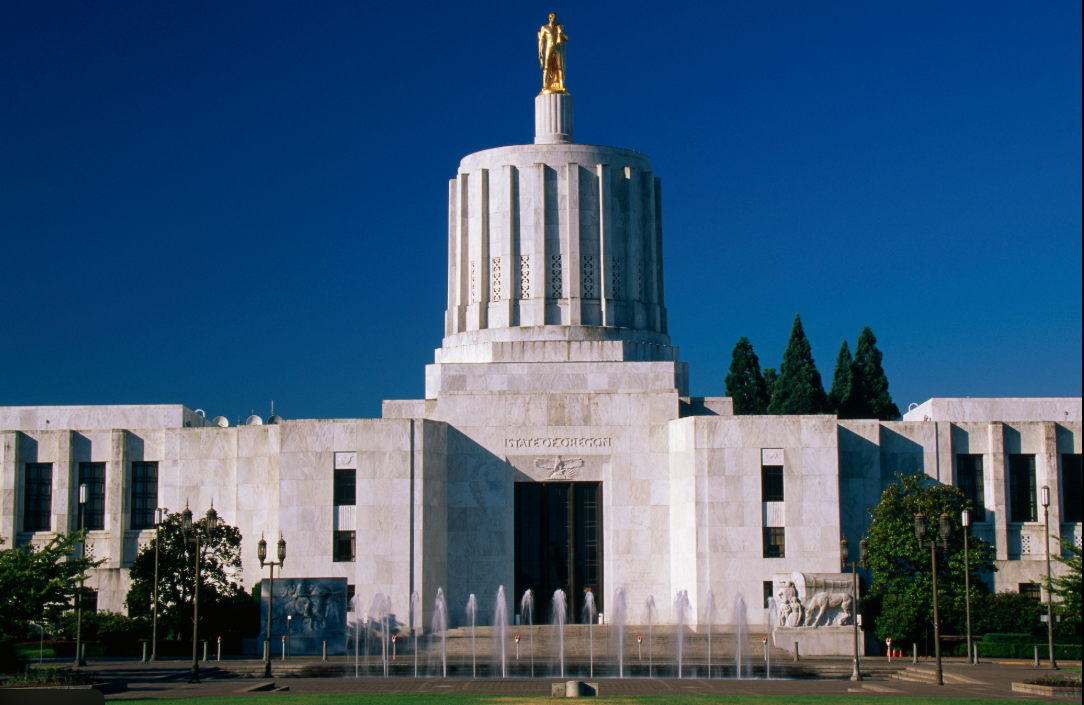
I began my visit at the Oregon State Capitol, the symbolic and political heart of the state. Its modernist design immediately sets it apart from the classical domes common in many U.S. capitals. Clean lines, symmetry, and open grounds convey order, intention, and permanence.
Walking along the Capitol Mall, I reflected on the role this building has played in shaping Oregon’s identity. This is where laws were debated, passed, and enforced—laws that determined access to land, opportunity, and belonging.
Standing here reinforces a sobering reality:
laws do not merely organize society—they define who is included within it.
The Capitol commands attention not just for what it represents today, but for what it sanctioned in the past.
Stop 2: Hallie Ford Museum of Art
Located adjacent to the Capitol, the Hallie Ford Museum of Art offers a meaningful contrast to the authority of government buildings nearby. Compact in scale but rich in substance, the museum features rotating exhibitions with a strong focus on Oregon artists, Native histories, and regional narratives.
This stop felt intentional. Where the Capitol speaks through policy and legislation, the museum speaks through culture, memory, and interpretation. It provides space for stories that formal institutions have historically minimized or excluded.
The proximity between the Capitol and the museum feels symbolic—almost deliberate. Together, they highlight the tension between official history and lived experience, reminding visitors that memory is shaped not only by laws, but by whose stories are allowed to endure.
Riverfront Park, the Willamette River, and Crossing the Bridge
From the Capitol area, I continued on foot toward Riverfront Park, moving away from Salem’s governmental core and into a space shaped by land, leisure, and public life. This transition felt natural—almost necessary.
In the park, I encountered the large World Map sculpture, an unexpected but fitting landmark. Standing atop a map of the world in a state capital once defined by exclusionary laws invites reflection. It quietly contrasts ideas of global interconnectedness with a local history of restricted belonging.
Continuing along the Willamette River, I eventually crossed the bridge, gaining a wider view of the city and its geography. The river anchors Salem both physically and historically. It existed long before statehood, long before legislation, and long before the institutions that now overlook it.
This movement through the city felt symbolic rather than accidental:
- Power at the Capitol
- Culture through art and public spaces
- Land through the river and park
Walking this route tied Salem’s story together in a way no single site could on its own.
Salem’s Riverfront Carousel: Community, Craft, and Joy
I also visited Salem’s Riverfront Carousel—and I got on.
After engaging with heavy themes of governance, exclusion, and historical memory, the carousel offered a grounding and human moment. Its hand-carved figures reflect community craftsmanship, care, and collective effort—qualities that don’t often appear in legislative buildings but are just as central to a city’s identity.
Riding the carousel wasn’t simply about nostalgia. It was about balance. Cities are shaped by institutions, but they are sustained by people. The carousel stands as a reminder that joy, creativity, and shared public spaces coexist alongside power and policy.
In Salem, that contrast is part of the story.
Why Salem Matters
Salem may not overwhelm visitors with spectacle, but that is precisely why it matters. This city demonstrates how exclusion can be:
- Orderly
- Bureaucratic
- Quiet
- Legislated
Not every injustice announces itself loudly. Some are written carefully into policy and enforced through routine governance.
Visiting Salem is not about drama—it is about understanding how power operates, how memory is curated, and how history is preserved or erased. Walking its streets connects architecture to ideology, and land to legacy.
Having the freedom to explore the city on my own terms—moving easily between government buildings, cultural spaces, riverfront paths, and community landmarks—made it possible to experience Salem fully and intentionally.
This stop on my Oregon journey reinforced a central truth of travel: it is not only about what we see, but about what we are willing to confront.